Thursday, May 29, 2025

White Ledge Peak, Peak 4271, and King's Crest

05/13/25


Ah man. I'm always overcome with an immense feeling of reluctance every time I wake up on the morning of a climb to White Ledge Peak. Every. Dang. Time. I sit in bed and think about the long miles, the crazy elevation gain, the bushwhack to the summit, the thousands of ticks. And I think to myself, "do I really want to do all that?" And the answer is always no, but I get up out of bed and get ready anyway. Getting out of bed, I've found, is the hardest part of the day. If you can get out of bed, you can conquer the world. 

I organized my things, packed up three liters of water, some snacks, and then hit the road. The plan was to reach a sub peak of White Ledge Peak. It's a little rocky promontory with no name and, quite possibly, no ascents. It was an ambitious goal for sure. In order to get to this sub peak I'd have to climb White Ledge Peak first, an already difficult task. Then I'd have to descend a brushy ridge for a ways, encountering unknown obstacles along the way. I had no beta on the ridge other than the last time I saw it from the summit of White Ledge Peak. That was eight months ago. At the time, the thing looked untrammeled, steep, and very brushy. Eight months later, and it was likely even more brushy. But I had to give it a try. I've been lookin' at that sub peak for most of my life. Had to see what was up there, you know?

So I drove to the trailhead, noticing a thick layer of clouds covering much of the Santa Ynez Mountains. The morning was chilly and crisp, a thankful relief from the heat that had choked much of the area for the past few days. I started walking a little after 6am, walking up Matilija Canyon towards forest route 5N13. No one was out and about. Nothing but the sound of the creek and the dirt crunching under my feet. The early light of the rising sun shone pink on Old Man Mountain and its twin summit, turning bright and gold as the morning drew long. 


The wildflowers were out in full force. Lupine, monkeyflower, ceanothus aplenty. I found myself stopping far too often to snap pictures of these flowers in the early morning light. Much of the surrounding foliage possessed a deep green hue, so the occasional patch of purple, pink, yellow, orange and blue really stood out—a feast for the eyes. 

I walked along the washed out road, slowly gaining elevation. I noticed a small cairn that marked the junction with the Murietta Trail that I hadn't noticed last time. By this point, the sun was well beyond the reach of the eastern mountains, now able to pummel everything with its warmth uninhibited. I worked up quite the sweat walking up the steep grade in the sunshine. But I had done it before and I knew what to expect. I reached the Murietta Divide in good time, stopping briefly in the shade for water and a light snack. 

Heading up the ridge

Next came the steep slog up the Monte Arido trail to ridge line of the Santa Ynez Mountains. I'd only done this once before and remembered it being no fun at all. The second time around was no different, if not a little worse. The last time I slogged up this trail, it was soaked in fog and freezin' cold. This time it was nice and warm and sunny...and full of ticks. Ticks galore. Every time I walked through a chunk of brush I'd pick up a bunch of the unwanted hitchhikers. But that's just the way it is this time of year in the southern Los Padres. It's just something you gotta deal with. 

Murietta Canyon

Jameson Lake


"King's Crest"

The views, of course, were outstanding on the way up. To my left I could look all the way back down what I had just traveled—Murietta Canyon and Matilija Canyon—and beyond that the Topatopa mountains, Nordhoff Peak, and the vast swath of the rugged Sespe Wilderness. To my right I could see Jameson Lake and the long extension of the Santa Ynez Mountains, running west as far as the eye could see. The wild and remote Dick Smith Wilderness stretched before me, the names of its peaks and creeks and trails and camps a mystery to me. I am not too familiar with that tract of land. I've only ventured into its depths once, and that was eleven years ago. To me it is truly wild country, a mysterious and alluring place that I'll never fully understand. 

As I approached the ridge line of the Santa Ynez Mountains, I noticed a wall of clouds rushing over the tops of some of the higher peaks. Seems like the cloud cover I had observed earlier that morning hadn't burned away quite yet. Good news for me. I welcomed that cloud cover. It would protect me from the wrath of the sun. 

Ocean View Trail Western Kiosk


Sure enough, as soon as I gained the ridge, I was met with a wall of clouds. No view, but it was considerably cooler, dare I say a bit chilly. I reached the western kiosk of the Ocean View Trail and pressed on, heading east, following the undulating trail as it wound its way along the ridge. I knew I had to go about four miles to reach White Ledge Peak, and I knew it was somewhere out there, laying in wait. But I wouldn't see it until I got there; the clouds were too dense. So I put my head down and started banging away the miles, walking through the clouds, my shirt flapping in the wind. 
Bench #11


Monkeyflower

Elevation lost, elevation gained. I followed that trail, putting one foot in front of the other, following it up and down and down and up. It was in excellent shape, all thanks to the great efforts of the Get It Done Crew. Without them, this trail wouldn't exist, plain and simple. 

This being my first time approaching White Ledge Peak from the west, I can definitely say that it's a whole lot easier and much more pleasant than the approach from the Ventura River Preserve. Excepting the horrible climb up to the Divide, much of the route was a nice, gentle up and down along a scenic ridge. Every now and then there'd be a break in the clouds and I would catch a glimpse of the view to the north. Murietta Canyon, Matlija Canyon, Cara Blanca, Old Man Mountain and beyond. The views to the south were still blocked by the clouds, and them clouds didn't look like they were gonna go away anytime soon. Fine by me. I kept trucking along, moving with the clouds, following the ridge as it took me towards my goal.

Bench #10


Before long, I reached the turn off for White Ledge Peak. It wasn't marked, but I knew where it was 'cause I'd already climbed the thing twice before. Some things you never forget. I couldn't see the peak, couldn't see much of anything really, but I knew it was out there, waiting. So I put away my trekking poles, rolled down the sleeves, and prepared for the minor bushwhack that separated me from the summit. 

Sure enough, the brush was worse than I remembered. Head-high scrub oak, ceanothus, and some charred branches of chaparral long since burned in the Thomas Fire blocked my way. I used the charred remnants to pull myself through the sea of gnarly brush, making my way bit by bit, trying to find the path of least resistance. After making it through a particularly rough section, the rest of the way was pretty easy, all things considered. Animal trails through stomach high brush seemed to be the name of the game. The clouds cleared a little, the summit came into view. I imagined myself on the summit and—voilá—I was there. 

White Ledge Peak summit


Not much of a view...

I couldn't find the register the last two times I was on this blasted mountain. Third time's the charm I guess. Unfortunately, whoever was up here last had placed the register upside down, the smaller of the two cans on top. The thing was filled with disgusting brown water and the register was completely soaked and severely water damaged. Many of the entries (which weren't that many to begin with; this mountain gets very little traffic) were completely illegible. Some of the pages were fused together, and when I handled the booklet, the thing threatened to fall apart at any moment. 

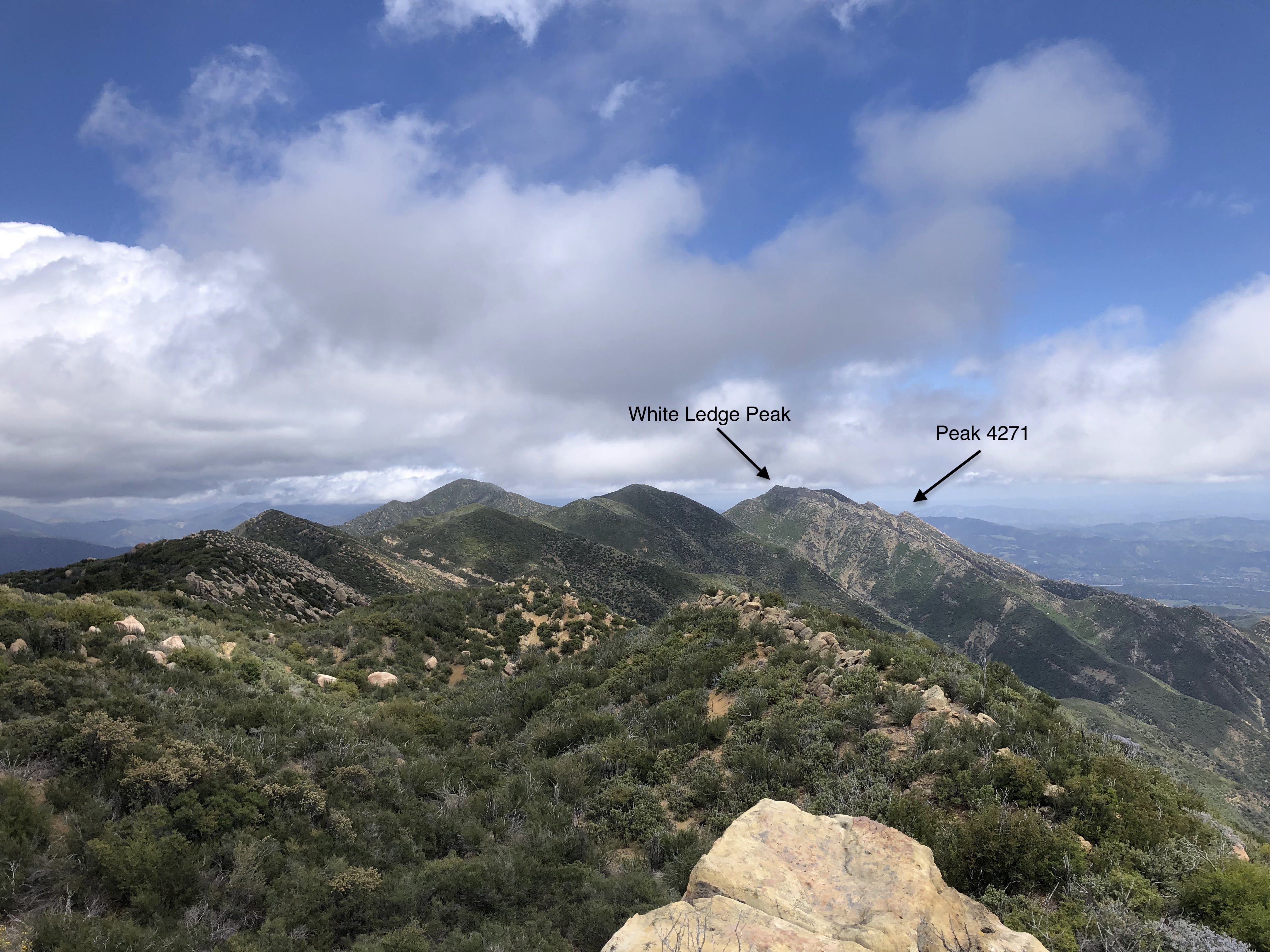
The last legible entry was from January 7th of 2023. I wanted to sign it, but I had to let it dry first. So I got out my stove and sat there on the foggy summit for a good 30 minutes drying it out, being careful not to burn the pages. I made some progress, but not much—the thing was far too soaked. So I let it air out a bit, let the wind dry it. The clouds had now lifted a little, and I could see clear, uninterrupted views to the south, including the route to Peak 4271. I thought that maybe by the time I got to that peak and back, that maybe, just maybe, the register would be dry enough to sign. So I ditched my trekking poles, laced up my shoes, and started for the adventurous descent into the unknown.


It's been awhile since I've done something new. It's quite exciting, I tell yah. Each step I took down that ridge was a step into the unknown. And maybe it was true that I was the first person to ever take those steps. Had anyone else travelled down to this sub peak? Maybe. It's probable. But you never know. All I can say is that my tired legs were no longer tired. I was high off the thrill of adventure, trotting down that brushy ridge and taking it all in, piece by piece. 

The ridge itself was steep, but not too brushy. Ok, it was really brushy I'll admit, but it was easy to get through. Stomach-level seemed to be the average, some patches shorter, others head-high or taller. I was making excellent time down the ridge, the rocky summit of the peak in my sight. Each step farther down built up my confidence. "Wow," I thought, "I'm actually gonna do it."

And then I encountered the crux of the day, a small patch of brushy white boulders that severely inhibited my progress. They were a bit tricky to navigate, involving some mild scrambling and one section where I had to shimmy up and through a dense chunk of California Bay Leaf. After that, it was easy street—scootin' and jumpin' and sliding proved the best way to get through the remaining boulders.

Ahh, the summit was close. I could taste it. I just had to descend to a saddle and then climb up the damn thing. It didn't look bad at all, just a little brushy. I had been eating brush for the past half hour. I was used to it; this last little chunk wasn't gonna scare me off now. I was ready, the excitement of a possible first ascent fueling my legs with an energy that I didn't know they had. 

Peak 4271

Summit boulders

I banged out the last little climb to the summit in no time. Several boulders and sandstone formations rested on the top, wind-worn and full of holes and divots. There was a large, somewhat flat spot on one of the formations that would be great for pitching a tent. Why you would bring a tent all the way up there, well, I don't know. Probably wouldn't be worth the hassle to be honest.

I found no evidence of anyone having been up there at all. No register, no carvings, no graffiti, no trash, no cairns, no secret treasure. Absolutely nothing. Seems like everybody stops at White Ledge Peak. And that's a real shame, because the views from this peak are far superior in every way. 

West

South

East

North, looking back up the ridge to White Ledge Peak

North, south, east and west, the views were more crisp, more vibrant, more hard-won than those on White Ledge Peak. The greatest views of all were of the Pacific Ocean. Though the day I summited wasn't particularly clear, I could still see three of the Channel Islands. I'd imagine on a clear day you could see all of them. Unobstructed views of the ocean stretched from Carpinteria all the way down to the Santa Monica Mountains. To the south was the best view of Lake Casitas I've ever seen from any peak, and to the east were tremendous views of the Ojai Valley and the Topatopa mountains.   

As I sat there taking in the view, I decided to unofficially name the peak "Ocean View Peak" because of the spectacular ocean views. I don't know if this peak has another nickname or what, but that's what I'm calling it, and that's what I wrote on the brand-new register I placed on the summit. Ahh, but what's a register without a glaring mistake? This seems to be a pattern with me. Way back in 2022, when Liam and I placed the new register on Cara Blanca, I didn't notice until later that I had spelled "ammo can" incorrectly. Oh well. That can slide. The mistake I made on this one is far worse.

I'll be honest and say that I didn't really look too hard on the ol' map for the official elevation of this peak. Glancing at Bryan Conant's map of the Dick Smith and Matilija wilderness, I saw the elevation of 4,000ft on the summit of this peak. Ergo, I marked the elevation of the peak in the register as "Peak 4000." Unfortunately, it wasn't until after I had gotten back from the summit that I realized I'd made a silly, silly mistake. If I had looked only a little closer at the map I would've seen an extra contour line, and I would've discovered the true elevation as 4,271ft. Oh well. At least it's written in pencil. If anyone else makes it to the summit, feel free to correct my error. 

Ignore the incorrect elevation...

New register

I placed the register near the highest of the summit boulders. First ascent or not, at least there's evidence of someone having been there now. I took one last sweeping view of the area, snapping a few pictures of the the cool erosion features on some of the rocks. It occurred to me that it was quite likely that I'd never set foot on this summit again. Time will pass, the brush will grow thick, the thing will become increasingly more difficult to reach. What to do upon this startling realization? Shrug your shoulders, say "ehh," touch a rock, and then leave. I added in a little salute before I left. Gotta show respect to the mountain. 

The crux

It took me about half an hour to go from the summit of White Ledge Peak to the summit of Ocean View Peak. Going back, it took nearly twice as long. Despite my hard-won knowledge of the route, I still had to contend with the steep grade. Believe it or not, going up is a lot more strenuous than going down. Ain't that something? 

White Ledge Peak


Back on White Ledge, I found the register flapping in the wind. It had gone from sopping wet to damp and moist. Not dry, not even close, but much better than when I'd first found it. I carefully etched my signature in the booklet, mindful not to tear the page. Then I put it back right side up, gathered my things, took one last look at Ocean View Peak, and then booked it off the summit. The clouds had come back now, and everything was once again soaked in a thick fog. Goodness gracious, what lucky weather! Doing this hike in the heat would absolutely suck.

Back on the trail...

Ceanothus


I was in great spirits on the way back. A successful summit is always great for morale, but this one felt particularly good for some reason. The clouds ripped across the ridge, pouring across the trail and then falling into Murietta Canyon. It was almost as if there was a giant invisible cheese grater in that canyon that shredded these clouds into tiny pieces and sent them on their way northeast. I stood on an overlook and watched the scene go down. I was now witnessing for the second time on this ridge the strange dance of the clouds. No brocken spectre this time, but it was interesting nonetheless. 

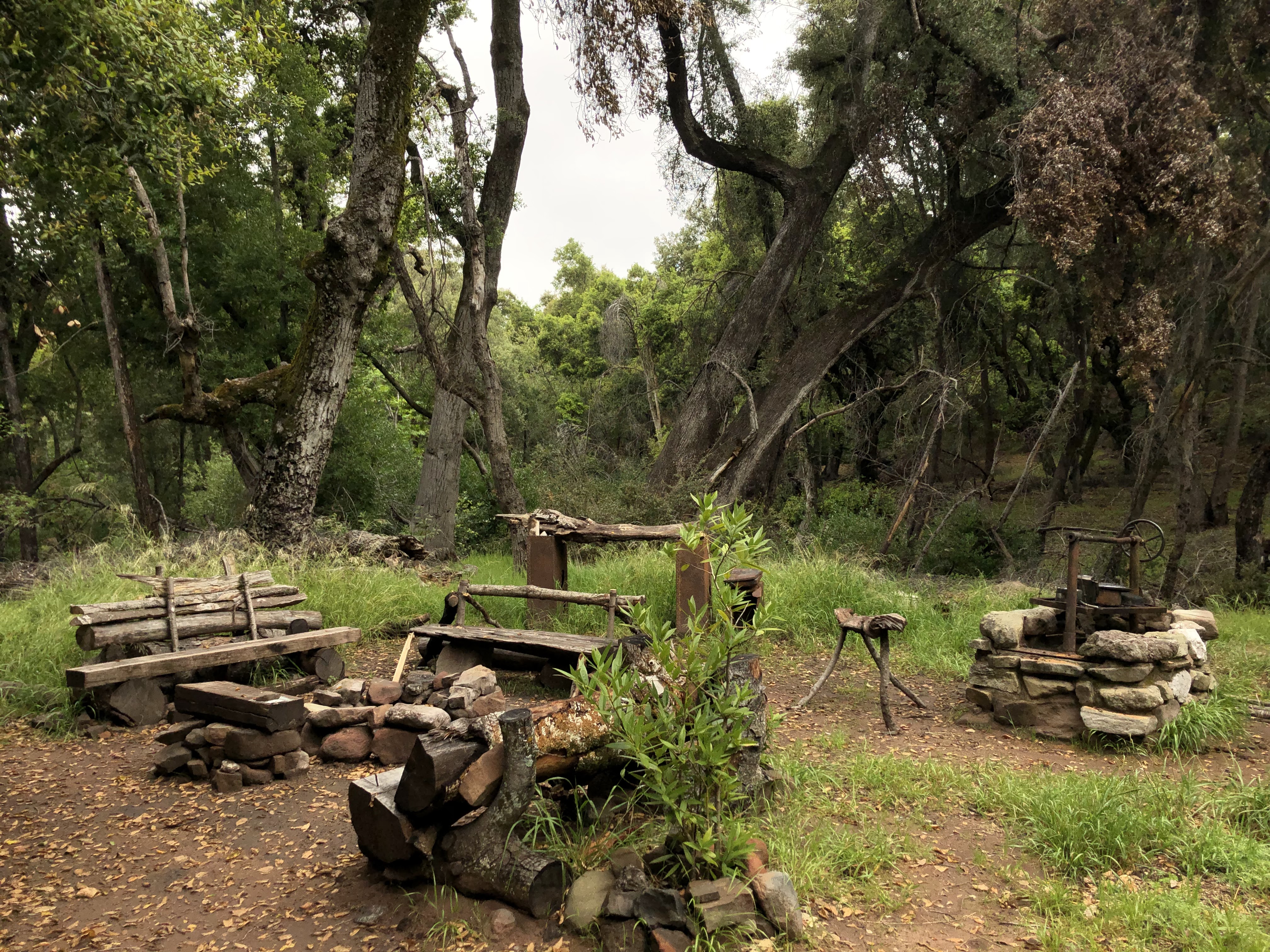
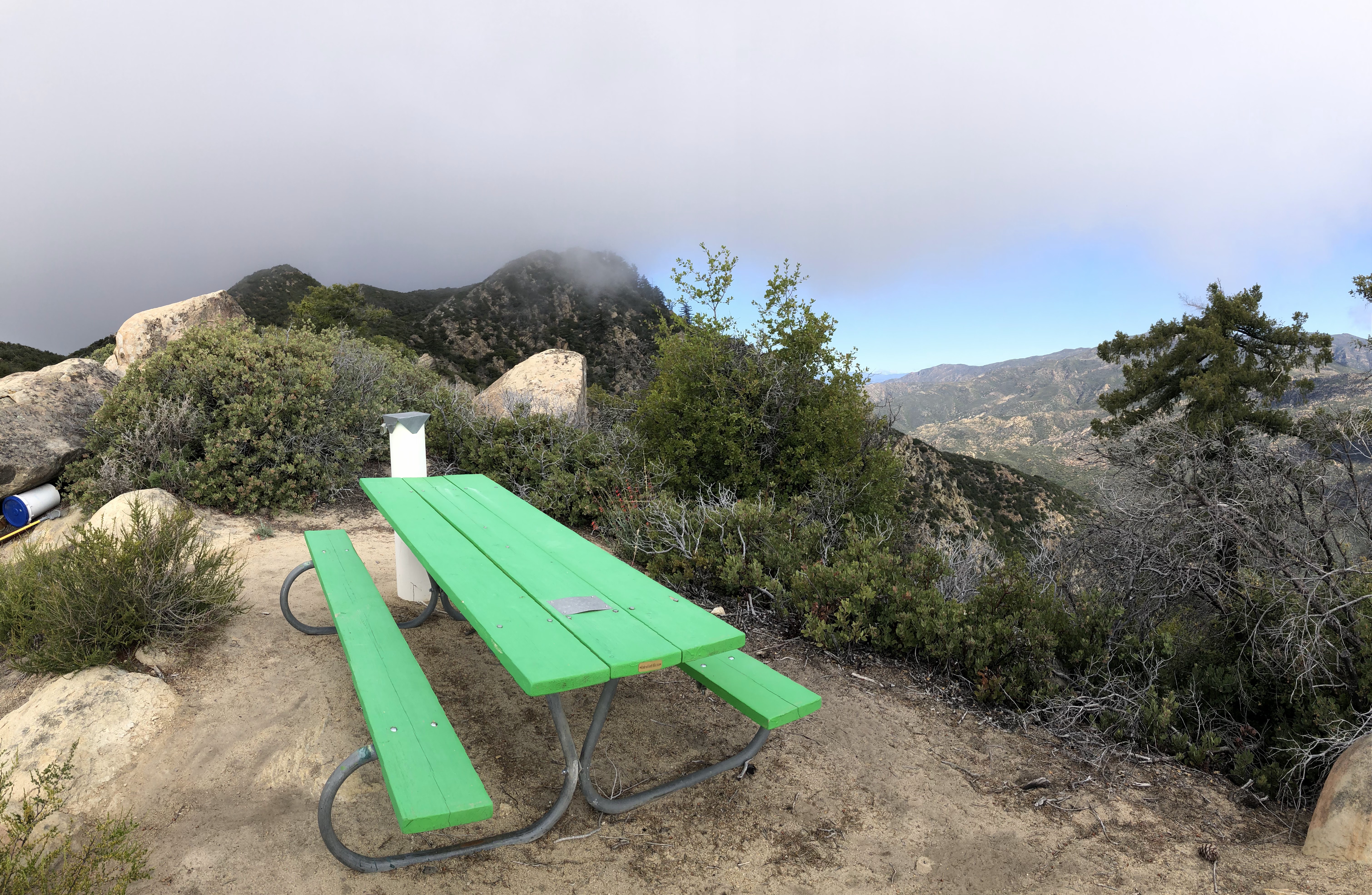
After some time wandering along the ridge in the grey void, I stumbled upon Bench #11. I decided to take a break there. The endorphins were beginning to wear off, the lactic acid in my legs now noticeable, the fatigue present. I downed more calories and electrolytes, sitting on the bench and staring at a blank wall of clouds. 

And then, much like on Divide Peak last year, for absolutely no reason and with no warning, all of the clouds burned away. The Ocean View Trail soon lived up to its name as I was presently gifted breathtaking views of the mighty Pacific Ocean. Anacapa, Santa Cruz, Santa Rosa, and a very shy San Miguel were all in sight, little blotches of dark green and deep brown in the mass expanse of blue. I got going, the day not getting any longer, walking farther down the trail. White Ledge Peak and Ocean View Peak came into view, no longer encased in clouds. They stood a long ways off. I found it crazy that I'd actually climbed the things not too long ago. Had I been able to see how far away they were when I had started, I might have had second thoughts. 

Rock formations near Divide Peak

I updated my entry in the western kiosk, again mislabeling Ocean View Peak as "Peak 4000." Farther down the trail, I took a few minutes to observe some of the cool rock formations near Divide Peak. And then, for no particular reason, I decided to climb King's Crest. Why not? It was nearby and I knew the route and it would make a great end to a fantastic day. It was settled: I found the drainage, ditched my trekking poles yet again, and then scurried up through the pokey brush to the summit of King's Crest for the second time.

King's Crest: view west

King's Crest: view east

I was surprised to see two entries since the last time I was there; one on December 16th of 2024 and one from January 11th of 2025. I left my signature and a few details of the day, once again adding the incorrect elevation of Ocean View Peak. The weather had warmed a little, the sun now a little meaner, but my goodness were the colors fantastic. Afternoon sunlight paired with the shadows of puffy clouds made for an incredible scene, everything within sight vibrant, green, beautiful. I spent a good half hour on the summit, soaking in the views, watching the shadows dance on the hills and mountains. I didn't want to go. But it was getting late and I had no choice. Reluctantly, I packed up my things and said my goodbyes to the summit.

Back on the road...

Downhill, down, down down, knees crying, legs shaking, feet aching. I took another break near the top of Murietta Divide, laying in what little shade I could find. I drank the rest of my electrolytes, ate the rest of my food. The hard part of the day was over. Now all that remained was the long downhill back to the trailhead. I turned off my brain and set off, flicking ticks off my pants every fifteen minutes or so.

Dodder!


Blue Heron Ranch

There was a LPFA truck parked at the trailhead for the Murietta Trail that wasn't there that morning. Nobody was in it, nobody was around. I completed the day without seeing a single soul other than me, myself and I. The whole endeavor took a little over eleven hours, a combination of the difficulty of the hike and taking the time to enjoy the scenery (and drying out the register). It had been a spectacular day, one of the best day hikes I've ever done. 

As I said at the beginning of this blog post, I'm always reluctant to make the trek to White Ledge Peak. But I forgot to mention that I'm also always reluctant to leave the summit. Every time I've been on that ridge it's been awesome, in every sense of the word. I love the sights, the sounds, the hardy feel of the brush and rocks on my fingers and the cool taste of the clouds on my tongue. Even the smell is great, no matter the season. It always smells fresh up there, a crisp, pleasing aroma of rugged soil and coastal chaparral. It's a magical, truly unique place, and one that I'm always bummed to leave. 


Sunday, May 18, 2025

Arlington Peak, Cathedral Peak, and a Lesson in Dehydration

 05/08/25


I ripped off my toenail when I returned home from Bluff Camp. The thing was stupidly loose, like a baby tooth barely clinging to the gums. Fluid leaked out from the nail bed; sounded like some air was escaping. I squeezed the sides of the nail, stuck my thumb underneath the top, lifted it, and then ripped it clean off. A sensitive membrane was now exposed to the world, ready to grab life by the horns. 

It had been a little over two months from the time that I blackened the nail to the time that I ripped it off. And when I had that nail on my toe, I was doing things. Climbing mountains, crossing creeks, busting through brush. Long miles, sunny days. When I lost that nail, I lost some drive. The nail seemed to be the only thing saving me from sloth. Now that it was gone, I had no motivation to do anything, especially if it related to the outdoors. 

I didn't do anything for almost two weeks. Maybe I did it to let the membrane harden a little bit. I don't know. What I do know is that I needed to get back out there and do something I've never done before. Enter Arlington Peak. 
I've known about Arlington Peak for a few years now. I've seen it many times while driving up and down the 101 freeway, its rocky summit beckoning adventure. It looked like a relatively easy peak to reach, short and steep. Additionally, when viewed on a map, it looked possible to connect a few other peaks as well, turning the whole endeavor into a nice little loop. It would go something like this: start at the Tunnel Trail, leave the trail and climb Arlington, walk over to nearby Cathedral Peak, and then ascend La Cumbre Peak. After that, follow Camino Cielo east down to the northern terminus of the Tunnel Trail, and take it all the way back to the trailhead. Staring at the map, this looked feasible, with relatively low mileage. So, on the 8th, I decided to give it a look. 

I left home around 9:30am with hardly any food and only one liter of water. I've brought the same supplies when hiking up to the Nordhoff lookout tower without suffering any issues, so I figured it would be enough for this hike, especially since it would be shorter mileage-wise. Hahaha. One would think I've learned my lesson about never underestimating the difficulty of a hike. Cobblestone Mountain was a prime example of that. But here I was, nearly a year later, making the same mistake. If I didn't learn it on Cobblestone, maybe Arlington would hammer it home (spoiler: it did). 

I made it to the trailhead a little after 10:30am. Lots of people out and about. Had to park in the overflow "lot" a bit farther down the road, requiring a bit of a road walk to get to the trailhead. I walked with a gait that was measured and fast, passing many people as they casually made there way to wherever they were going. Bikers, hikers, trail runners—everyone was there, a lot of them heading back down the trail. Those that were heading in were likely going to the waterfalls up Mission Creek. I don't blame them. The heat was already quite noticeable, only interrupted by a faint, cool breeze. Spending the day in a nice cold creek would be far more pleasant than slogging it up steep mountains. Takes a special kind of stupid to do something like that. Good thing I fit the bill. 

Mission Creek

I made it to Mission Creek in a flash, taking a little breather in the shade. The water was dirty in some of the more shallow pools, algae and muck covering much of the surface. The creek trickled gently down the canyon, lazy and carefree. I looked around a bit, absorbed the vibe of the place. It was here at Mission Creek where I would start the climb to gain the steep ridge that would take me to Arlington Peak. Only problem was that I had done zero homework on the route and had no idea which use trail to take. There were a bunch of 'em, all snaking in different directions. I'd take one and follow it for a ways, then it would fork and I'd go a different way. I figured that as long as I was going up, I would be fine.

Onward and upward

The use trails were well-worn but very steep. Sometimes they were clear of brush, sometimes I had to bend over and squat-walk up a brush tunnel. At one point my chosen use trail eventually spit me out on what looked like a defined path, so I stayed on that for as long as I could. I noticed Vans prints in the dirt and hypothesized that this was the proper route to the ridge.

I was correct, the thing took me all the way up to the ridge lickety-split. There were a few instances of mild class 2 scrambling, but for the most part the thing was pretty easy, albiet steep. Once on the ridge, I had tremendous views of the surrounding country and a clear picture of the coming slog to the summit. It looked steep, sunny, hot, but fun. I spent a few minutes catching my breath and then off I went, snaking in and around multiple sandstone boulders.

Arlington Peak

I found the ridge very interesting. Huge sandstone boulders, worn and rugged and covered with lichen, stood in stark contrast to the brilliant green of hardy chaparral. Holes, divots, bumps, hollows galore. The place was a scrambler's paradise. So much to see, so much to explore.

The "trail" was fairly easy to follow, marked with painted white dots and some black arrows. I'd weave in and out and around a bunch of formations, sometimes ducking under them, sometimes going off trail to inspect small caves. I was having a blast, but I was burning through my water supply too quickly. It was much hotter than I had expected, the sandstone absorbing the heat of the sun and then shooting it back out like a gigantic radiator. The strenuous grade wasn't helping much. My heart was beating out of my neck, my body drenched in sweat. I started conserving water, hoping to make it last. 


Some scrambling required

I followed the "trail" as it curved to the southeast side of the mountain. Here, route-finding was a little more difficult. If I wasn't paying close attention, I'd soon find myself scurrying up some class 4 boulders. No bueno. I turned around a few times, always searching for those Vans footprints. They were a good indicator of the path of least resistance. 

Arlington Peak Summit

I followed the Vans footprints to the summit, a rocky and brushy place with very little shade and a whole lot of sunshine. I had drank half of my water supply by this point and was just starting to feel the effects of mild dehydration. A bit tricky to swallow, some mild dizziness, fatigue, golden urine. Yup. Been there before. I knew the drill. 

I scrambled up to the summit block, a lone boulder that overlooked the whole scene. It had a little hole in the side of it where someone had placed a big ol' plastic insect. I didn't find a register, but then again, I wasn't looking for one. I sat on the summit and admired the views. The whole swath of Santa Barbara and Goleta lay before me to the south, the ocean hazy from the morning fog, the Channel Islands barely visible. Another boulder, carved with the names of those who had conquered the summit, lay in my field of vision. It looked like a work of modern art; so many names, all carved in different years, some fresh, some so old and weathered I couldn't even tell what they said. 

I pondered my situation. To the east I could see the Tunnel Trail snaking its way down from Camino Cielo. It looked far and hot. To the northwest was Cathedral Peak, a rocky knob in a sea of brush. To the north rose La Cumbre Peak, the lookout tower on its summit small and unassuming. I had half a liter of water left. I could possibly make it last to La Cumbre Peak, but after that I'd be SOL. Maybe I could just coast the downhill from La Cumbre back to the trailhead. Who knows. Not wanting to waste any more time and energy thinking about it, I got up, grabbed my stuff, and headed towards the second objective of the day: Cathedral Peak.

Cathedral Peak

The route to Cathedral Peak was very easy to follow. I lost some elevation on the way over but quickly gained it back as I approached the base of the climb. From the base it was a very straightforward hike/scramble to the summit. There was a big ol' ammo can on the summit full of multiple register booklets and another plastic insect. The views were much of the same as those on Arlington. I signed my name, took a few pictures, and then scampered off the summit in search of the route to La Cumbre Peak.


View east, Arlington Peak right

View west

Cathedral Peak is a popular spot for rock climbers. As such, there are numerous use trails that surround the summit, all leading to different places. I'd follow one, hit a class 4 obstacle, climb down it, follow a faint path through the brush, and then hit an impasse. Then I'd waste a bunch of energy climbing back up what I'd just descended. Each trail I followed took me to a dead end. Lots of backtracking, lots of wasted energy. Things weren't looking good. I sat down, scratched my head. 

I decided to turn around. It was a tough decision, mostly because it meant that I had to admit to myself I was super lazy in the preparation for this hike and that it was because of this laziness that I wouldn't be able to complete the loop. Ain't nobody's fault but mine. And that was frustrating. My legs felt pretty good, I was still fairly fresh, but I was definitely dehydrated. Dry tongue, a little nausea, and I wasn't sweating as much as I was earlier. I had enough water to make it back, maybe. But for the loop? Not a chance. Plus, I had no idea how to get to La Cumbre Peak anyway. If I had studied the route beforehand it would've been a different story. Since I didn't have a map, I was stuck to wandering. If I took my time, I'd probably find the use trail to the summit sooner or later. But I didn't have time to spare. And so, with my hubris crushed, I turned around and made my way back to Arlington Peak. 

La Cumbre Peak

I spent a good fifteen minutes on Arlington Peak, soaking in the view, drinking the rest of my water. Man, if I'd only brought just one other bottle, things would be different. But that's the way things go sometimes. Had to learn the lesson the hard way yet again. I was so bummed with myself that I promised to never make the same mistake again. No matter the hike, I'm always bringing more water than I think I need. End of story. 

After my self-reflective-summit-introspection-session, I gathered my meager belongings and slowly made my way back down to Mission Creek. For some reason, it was a lot trickier following the trail on the way down than on the way up. I got off route a few times, finding myself cliffed out on one occasion. I retraced my steps, searching for those ever-reliable Vans footprints. 


I stumbled along, the rough sandstone doing a number on my fingers. I nearly stepped on a medium-sized rattlesnake at one point. The thing was sitting in the sun, minding its own business. And then I came along and ruined its afternoon. It coiled up in the blink of an eye and was ready to strike, its rattle buzzing in warning. I jumped about 800ft in the air. When I got back down to Earth, I made sure to be extra diligent where I placed my feet.

After a while of scooting, jumping, sliding and hopping down sandstone, I took a break in the shade of a pine tree and guzzled down the last few drops of water still clinging to the inside of my bottle. I laid on a pointy rock covered in lichen and pine needles, listened to the faint breeze rustling through the branches of the lone tree. I could here voices coming from far away. I sat up, looked around. Way off in the distance, out on the Tunnel Trail, I made out three dots, all of them moving at a brisk pace. Them's were the chattiest dots I've ever heard. They never let up. 

Back on the trail...


I zigzagged down the ridge, the route now very obvious. I saw some folks hanging out at one of the many waterfalls up Mission Creek. I could hear their voices as well. Crazy how far sound can carry in the wilderness. 

I followed the well-defined path the rest of the way to Mission Creek. There were a few people milling about near the creek. One of them asked me if I was coming from the falls, wanting to know how much water was up there. I said I was coming from Arlington Peak and they didn't seem to understand what that meant. 

I made it back to the car after a little more than 3½ hours of total walking. Sometimes, that's all it takes to get dehydrated in these woods. I had left a spare bottle of water in the car and guzzled it down in one go. The drive home left me time for more introspection. I was happy to finally get back out there, to see something I've never seen before. But I was also disappointed with my lazy preparation. I'll have to attempt this one again someday. Earlier start, more food, more focus, and definitely more water. 


Wednesday, May 7, 2025

Day Hike to Bluff Camp

04/27/25


Ah, Bluff Camp. What is there to be said that hasn't been said already about this legendary place? Abandoned, distant, hard-to-reach, beautiful, secluded, mysterious, alluring. Situated right on the border of "Bear Heaven," this place serves as a gateway to the sublime. Ancient fir trees, dense chaparral, red and purple sandstone formations, deep canyons, huge cliffs, impenetrable wilderness. Wild, wild country. Bluff Camp ain't just a camp. It's a holdout barely clinging to the vestiges of humanity, serving as a barrier between the known and unknown. I've wanted to see it with my own eyes for years now, to make the trek, to journey to this unique land of rock and oak and pine. Getting there would be difficult. But I had to see that it could be done. 

It was a clear morning, at least in some areas of Ventura County. I planned on meeting Carl at the trailhead at 6am, a fairly early start to what we we expecting to be a long, tough day. Neither one of us having a lot of time off, we'd both decided to attempt a day hike to Bluff Camp. This is not advisable, as a trek to Bluff Camp is certainly no easy feat. Sixteen miles roundtrip, nine of which are a mixture of cross-country travel, rock hopping, bushwhacking, and travel on trail so far gone that it basically doesn't exist anymore.


The skies remained fairly clear, the morning air crisp and cool. We started on the trail after a quick breakfast of sausage biscuits and a hash brown or two. Carl led the way with a blistering pace, neither one of us talking very much. Our idea was to chug out this easy section as fast as possible so as to give us ample time to navigate the brushier portions of the hike. Very few people were on the trail, all of them heading to the famous Punch Bowls. 

We made it to Big Cone Camp in record time, set our packs down and caught our breath. Someone had left an ice chest in the camp, completely empty except for a few slices of soggy, moldy cheese. A few empty aluminum cans and some plastic wrappers littered the ground, but no graffiti this time. We'd have to clean it up on our way back.  

After a little rest and a quick smoke, Carl and I set off on the trail, heading down the switchbacks to the east fork of Santa Paula Creek. We'd been up the east fork earlier this year and knew what to expect. We turned right, followed the trail until it puckered out, and then it was nothing but the creek. To our surprise, ALL of the orange flagging that we had seen earlier this year was gone. Very interesting. Someone must have taken it down. 

Heading up the east fork

Travel through the east fork was slow but pleasant. The water level was lower this time, making it very easy to keep our feet dry. The clouds started to roll in, blocking the sun, keeping the temperatures nice and cool. Verdant forest, imbued with the hue of brilliant springtime green, lined each side of the canyon, a feast for the eyes. Giant, moss covered boulders littered the creek, with strange riparian foliage hugging the banks, providing cover and shelter for creatures too shy to say hello. The farther we ventured up the east fork, the wilder the country, evidence of humanity disappearing with each consecutive step. 

We were able to find the spot to leave the creek and head to Cienega Camp by using our past knowledge of the area. We hadn't brought a GPS, so prior knowledge was crucial. The spot to leave the creek wasn't obvious whatsoever, the orange flagging that once marked the exit point nowhere to be seen. The only thing of note we found was a tiny cairn, two stones high, resting parallel to the exit point. We left the creek, scrambling our way up the side of a small rise, busting through brush to get to the trail that would take us to Cienega.


Good Lord. The trail was in much worse shape than when we did it back in January. Springtime growth had choked much of the trail, making it far more brushy than I had remembered. Add to that head high, unavoidable sections of poison oak and we had our work cut out for us. It had rained the day before, and all of the brush was still soaking wet. The cloud cover had prevented the sun from evaporating the moisture off of the brush, and we were promptly soaked. Shoes: wet. Pants: wet. Shirts: wet. Everything: wet. I had worn jeans thinking that they'd hold up well in a brush battle. They never ripped, but hiking in soaking wet jeans proved to be no fun at all. 

It was a slog to Cienega. Even with our past knowledge of the route we still lost the trail a few times, the new growth making navigation slightly annoying. There was no sign of anyone having been up there for a long time, no footprints to follow, no broken branches or bent brush. We took our time, eyes fixed on the ground, paying very close attention to the faint trail as it snaked its way through clumps of ceanothus and poison oak. 

Cienega Camp

We eventually stumbled out of the brush and into Cienega. Someone had cleaned up the place, fixing the benches and fire pit and grill and whatnot. It was in much better shape than when we had seen it back in January. We took a seat on the iconic table next to the oak tree and took a long break. I ate some bars, Carl ate more sausage biscuits and had another smoke. The clouds were in thick now, stretching across the sky. Santa Paula Peak was obscured in the clouds. And, to my dismay, the ridge up to Bluff Camp was obscured as well. Damn. That would make navigation difficult. Wandering through brush up a steep ridge to an abandoned camp in the fog would be a tricky feat. No view, no visibility. We'd have to be extra diligent. 

We sat for a while, mentally preparing for the next stretch. We knew this would be the hardest part of the day, and, not having any beta on the route, had no idea how bad the brush would be. Doubt creeped into my mind. But I let it pass. I was too busy shivering to be focused on failure. The temps had dropped, the clouds were gray, and my soaking wet jeans weren't making me any warmer. Time to get up and get moving. And so we did.


We knew we had to go in a straight line, pretty much directly north from Cienega, to get to Bluff Camp. So that's what we did. We followed the faint trail out of Cienega until it pretty much disappeared, only the slightest indentation in the earth noting its existence. We went through brush, found many animal trails, but each one of them took us to nearly impenetrable brush. This was not looking good. If we couldn't find the trail, it was clear that we weren't gonna make it to Bluff Camp. 

Just when I thought we were out of luck, I caught sight of some pink flagging. Hallelujah! We scurried towards it, looked around, found no evidence of a trail. But that was OK. The flagging meant that somebody had been there before, perhaps they knew the way. We went straight, looking for signs of humanity. And then—aha—I spotted a cairn on top of a boulder sticking out of the brush. I made my way towards it, telling Carl that I'd found something. And, sure enough, right beneath this boulder existed the remnants of a trail. A really old and brushy trail, but a trail nonetheless. My confidence surged. We might actually pull this off. 


Ahh, what a ridge. We'd follow the trail, look for cairns, our concentration sharp, our minds nothing but shear focus. But then the trail would disappear and we'd find ourselves in a sea of brush. Chamise, yerba santa, scrub oak, yucca, laurel sumac, ceanothus; it was all there, all of it head high or taller, all of it soaking wet and dripping with moisture. We became enveloped in the perfume of the chaparral, the brush scrubbing us clean like a giant, natural washing machine. It was a battle for sure, but we kept at it, straining our necks over the brush to look for flagging or cairns. And we'd see 'em, sticking out of the brush, and we'd fight our way over to 'em, hoping that they indicated relief. Sometimes they did, and that was great. The trail would reappear and it was back to fairly smooth sailing. Other times they didn't, often just serving as a waypoint, and we were back to slogging it through the brush. 

On the trail...

Trail sign: note the singular rock to the right of Carl

I knew we had to start heading east at some point, but the matter of when was a mystery. Lucky for us, the trail became a little more prominent near the upper portions of the ridge. We found us some switchbacks, a few cairns placed hear and there, and sure enough—the trail started heading east. We rounded a corner, marked by a small cairn, and then continued north. 

This is where things got interesting. The brush wasn't nearly as bad in this area (at least, not yet), but we had now entered the realm of the clouds. Couldn't see no more than 50ft in all directions. The temperature had dropped significantly, and walking uphill was no longer enough to keep us warm. I started losing sensation in my hands, my teeth starting to chatter. And just for the fun of it, the clouds unleashed a faint drizzle. Not that it would matter much, we were already soaked through from our battle with the brush. The drizzle just served as another annoyance, another obstacle to infect our minds, crush our spirits, sow the seeds of doubt to prevent us from reaching our destination. 

It was slow work; we had to be extra tedious. The trail was almost imperceptible. The brush wasn't too bad, but figuring out where to go was the tricky part. The drizzly fog didn't help at all. I started bending twigs and sticks as markers for our way back. Wouldn't want to get lost, especially in that weather.

With diligence and focus we were able to follow the trail until it lead to a point: on one side the land rose up steeply, almost like a cliff, and on the other was an open gray void of clouds. We were getting close. We'd follow the side of this "cliff" until it took us to Bluff Camp. Unfortunately, this last little section proved to be the worst part of the day. 

The poison oak was back, head high and unavoidable. Sections of trail were so choked with brush that they became nigh impassable, forcing us to skirt around and find another way. Progress was exceedingly slow, mostly from shear exhaustion. We had been hiking for over five hours, and we still had a long way to go for our return. I looked at Carl and asked him when he wanted to call it. He said, "I'm following you, but if you want to turn around I won't mind." Yep. That meant we had to call it soon. I said "Let's hike for another ten minutes." If we didn't make it in the next ten minutes, well, we'd just have to come back some other day and give it another shot.


I was having trouble gripping the brush to pull it out of the way. My hands were quickly losing feeling. "Jeez" I thought, "how cold is it up here?" And then, after clawing my way through a particularly dense chunk of brush, I saw snow on the ground. That answered my question. It was pretty damn cold. 

We steamrolled through the brush, giving everything we had. And then, suddenly, with no sign or warning, the trail opened up nicely, the ground clear and plain. Huge oak trees and ancient firs rose high overhead, with towering sandstone formations resting on either side of us. Hell yeah. We were close. 

The drizzle picked up to a light, chilly rain, the trees heavy and dripping with moisture. The area was almost completely silent, nothing but the sound of a gentle pitter-patter interrupting the stillness. More snow on the ground, more cold, tons of fog. I started laughing. This was awesome. Miserable, but awesome. 

And then, at long last, there it was: the lonely fire pit, the forgotten shovel, the remnants of the sign destroyed and splintered and swollen and damp. It was Bluff Camp. We had made it. 


Snow Plant

We did not stay long. I threw my pack down, shoved my hands into my armpits, and jumped around. Carl sat down on a log and had another sausage biscuit. The dude kept pulling them out of his pack like he had an endless supply of them. 

There we were, two loons existing in the quiet repose of the legendary camp. Couldn't see much. Everything was soaked in a dense layer of cold, misty clouds. The massive, sheer, moss-covered sandstone formations rose up and away into oblivion. Trees vanished in the fog, only their trunks visible. Numerous canyons beckoned exploration; the whole place exuded a sense of pure wonder and excitement. I had heard many things about this camp; what it looked like, what was there, who had been there, its close proximity to one of the most rugged, wild, and magical places in the entire forest. I had heard these things, pondered these things, and I can honestly say that, hopping around the fire ring with freezing hands and soaking wet jeans, everything said about this camp was true. The place is mystical. Ethereal. Unlike any place I've ever seen.


Lost in the Los Padres

There wasn't much in the camp. Just the fire pit, a couple logs, a few pieces of the broken sign, a shovel with no handle. I found Christopher Lord's register that he'd placed in 2019, but I couldn't open it. Hands were too damn cold. Couldn't get a grip on it. Oh well. These things happen some times. 

We probably stayed no more than five minutes in the camp. We came, we saw, and then we left. If the weather were better (or truthfully, if we had better gear) we would've stayed longer. But the cold was bothersome, and the skies were nothing but gloom. Carl finished up his sausage biscuit, I took a few more pictures, and then we said goodbye. 

We left Bluff Camp in silence. Nothing but the sound of falling rain and the quiet song of a few freezing birds tucked away in the cliffs. The clouds never abated, they never dispersed, they choked the land and sucked away all warmth. I crashed through the brush like a wrecking ball, no longer using my freezing hands to move it out of the way. 

Gravity was on our side. It was much easier going downhill through the brush and we made excellent time. We remained diligent, following the trail of broken sticks and bent branches that I created on the way up. Before we knew it, we were back on the ridge, out of the clouds, the east fork of Santa Paula Creek stretching far and wide before us, the views stretching out to Upper Ojai, Sulphur Mountain, the Santa Ynez Range, and even the tip of Santa Cruz Island. 

We took a more direct route on the way down. We'd follow the trail for a bit, then it would disappear, and then we'd use gravity to our advantage, steamrolling down through the brush until the trail reappeared once more. Eventually, we caught sight of a rock cairn far down the ridge, a little brown stain in a sea of green. We made a beeline to it, caught it, found the trail, and took it the rest of the way down the ridge. It spit us out just above Cienega Camp, near a gargantuan conglomerate boulder. We scaled the boulder, threw down our packs, and took a nice long break. 


The top of the boulder was level with the tops of most of the trees. We sat there for a minute, gazing upon the lush forest spreading out in all directions. I kept thinking how insane it was that none of this burned during the Thomas Fire. It would've been a real shame if it did, the scenery was stunning, absolutely stunning. 

Carl had a smoke and yanked out another sausage biscuit. I nibbled on some trail mix. Carl's gaze was fixed on a formation to the north east, a sheer, purply-brown cliff face with a big ol' crack running through it. Being a climber, Carl was instantly drawn to it the moment it met his gaze. Started talking about how he had to climb it one of these days, haul up the gear, spend a few nights at Cienega, put up a few routes, stuff like that. I mentioned that he'd probably be the first person to ever climb that cliff face, an idea that made the prospect even more alluring. I'm sure he'll be back one day. And if not, it'll definitely hold a place in his memory. 


We packed up our stuff, scurried off the boulder. We walked back through Cienega Camp, took a few more pictures, and then continued with our journey back down to the east fork. The clouds remained, but the weather had warmed a bit. My hands had regained sensation, my body, though still soaked, no longer tense and shivering. We rolled on down to the east fork like it was nothing. Broke through a few patches of poison oak, slipped on a wet log or two, and then we were there—back in the east fork, back in the creek.

Back in the east fork...
 

We were worn but happy, tired but satisfied, our legs spent but our souls fulfilled. We had achieved our goal. Now all that we had to do was get back to the trailhead. And so we bumbled along, no longer caring much about time. We scrambled down boulders, hopped across the creek, avoided some deadfall, found a few animal tracks. As we neared the end of the east fork, the spot where it meets the trail, I picked up a discarded plastic bag and started filling it with little bits of trash. A plastic bottle, an old bandana, a few wrappers, stuff like that. 

We met the trail, a godsend for the legs. We went up the switchbacks and took our longest break of the day at Big Cone. Carl sat on a log and had a smoke, I lay on my back, staring at the sky. A group of young men had set up camp at the first sight, the spot with the discarded ice chest. They had cleaned up the place a bit and were playing catch with a foam football. A few parties passed by, Carl engaging socially and giving directions to the Punch Bowls. We were in tremendously good spirits; the hard part was over. Nothing but smooth, defined, well-marked, brush-free trail lay ahead. We had it in the bag. 

We picked up a whole lotta trash on the way back. Mostly little things, like bottle caps and wrappers and stuff. There were many people on the trail, either coming from or going to the Punch Bowls. We passed one group of about fourteen people, all of them dressed in summer wear, all of them heading to the punch bowls. Families, students, couples, elderly folks, solo travelers, we saw them all. It was a bit strange seeing all these people after a day mostly spent in solitude. A shock to the senses. 

We made it back to the trailhead a little before 5pm. Carl and I hung around for a minute, sent each other some photos, and then parted ways. It had been an excellent day in the sticks, made more interesting with the chilly weather. It was great to finally get out there and see the place for myself, to experience it first-hand. And the best part? No ticks, no rash!